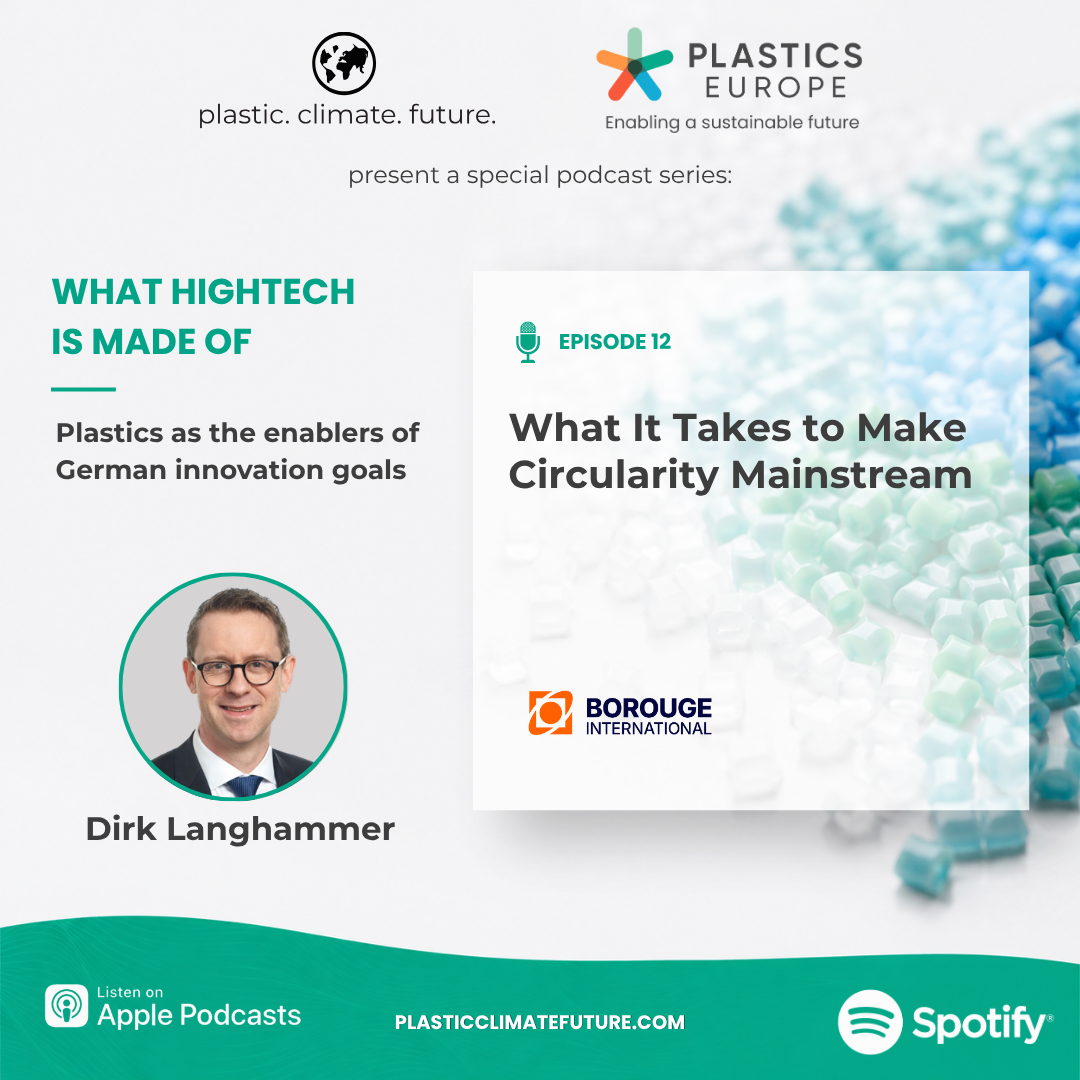
What It Takes to Make Circularity Mainstream

What It Takes to Make Circularity Mainstream

Circular plastics are no longer just a sustainability ambition. They are becoming a strategic business opportunity. But what will it take to move from early adopters to industry-wide adoption?

In the latest episode of our series with Plastics Europe Deutschland, we speak with Dirk Langhammer from Borouge International about the future of circular plastics and what needs to happen to make circularity the norm rather than the exception.

From mechanical and chemical recycling to renewable and CO₂-based feedstocks, the technologies are evolving. But technology alone isn't enough. Scaling circularity requires market demand, investment, collaboration across the value chain and a regulatory framework that creates long-term certainty.

We discuss:

  • Why mechanical recycling remains the backbone of circular plastics — and where newer technologies can complement it

  • How mandatory recycled-content targets can create demand and unlock investment across the circular value chain

  • Why Europe is leading the circular transition in some areas, but bureaucracy and slow approval processes risk holding back progress

  • How brands, recyclers and material producers can work together to make circular solutions commercially attractive

For Dirk, the outlook is optimistic. Circularity isn't just about reducing environmental impact. It's also about cost efficiency, reliable supply chains and resource security.

The opportunity is there. The technologies are developing. Now it's about creating the conditions for circular plastics to compete, scale and become part of everyday industrial practice.

Listen now on Spotify and Apple Podcasts!

Read More
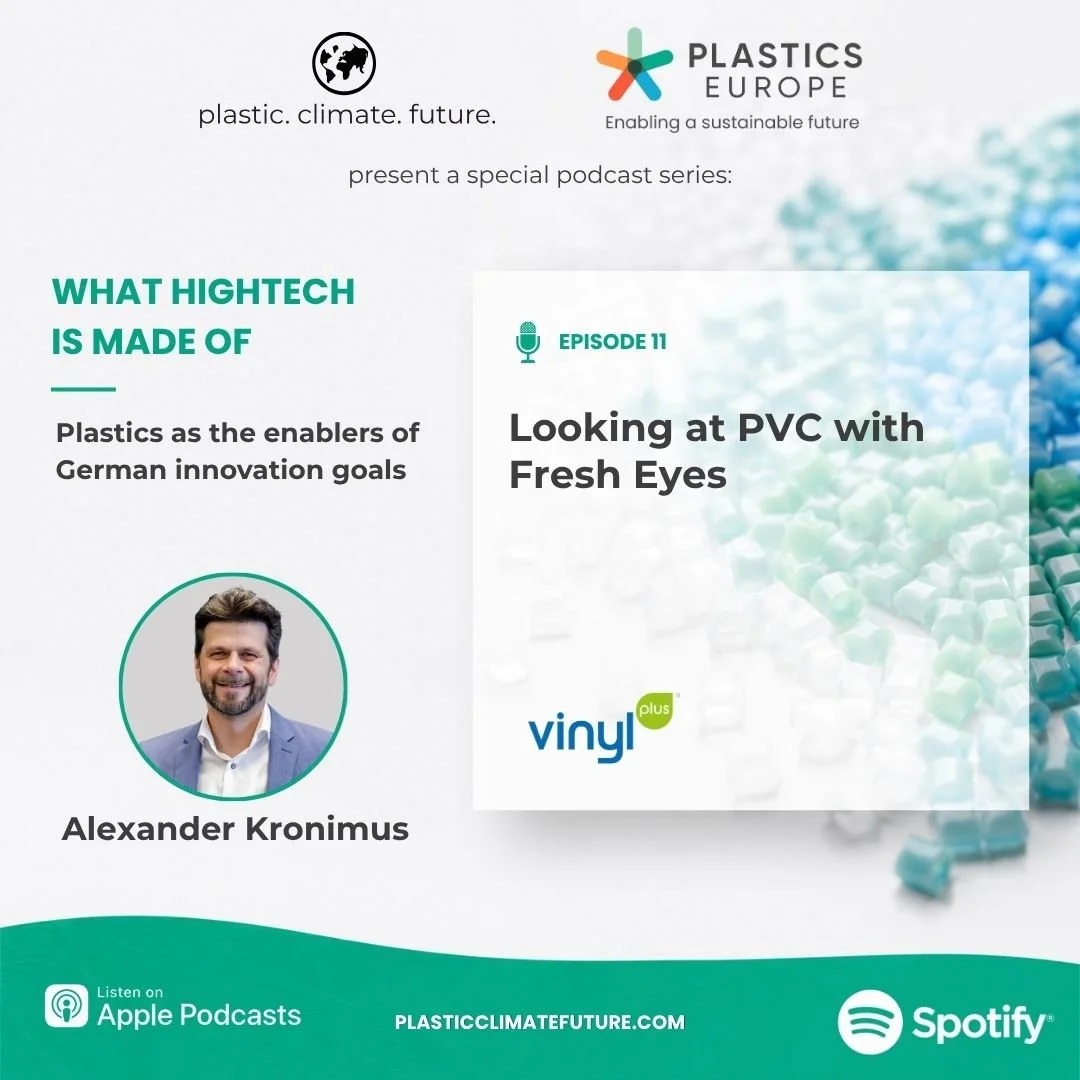
Looking at PVC with Fresh Eyes

Looking at PVC with Fresh Eyes

PVC has been around for decades — and so have many of the perceptions surrounding it. But how much has the material, and the industry behind it, changed?

In the latest episode of our series with Plastics Europe Deutschland we speak with Alexander Kronimus from VinylPlus Deutschland about taking a fresh look at PVC: where it is used, why durability matters, and how the industry is working to make an already long-lasting material more circular.

From window frames and cable insulation to medical applications and, of course, vinyl records, PVC is often an invisible part of the products and infrastructure around us.

We discuss:

  • Why circularity starts with smart product design — not just recycling

  • How durability and energy efficiency can make PVC an important material for buildings and infrastructure

  • How the industry is addressing legacy additives while developing new recycling technologies

  • How recycled and non-fossil feedstocks, renewable energy and innovation could further reduce PVC’s environmental footprint

Perhaps one of the most interesting takeaways is that sustainability isn’t simply about replacing materials. It’s about looking at their entire life cycle — how they are produced, how long they perform, and what happens when they finally reach the end of their useful life.

Sometimes that means looking at a familiar material with fresh eyes.

Listen now on Spotify and Apple Podcasts!

Read More
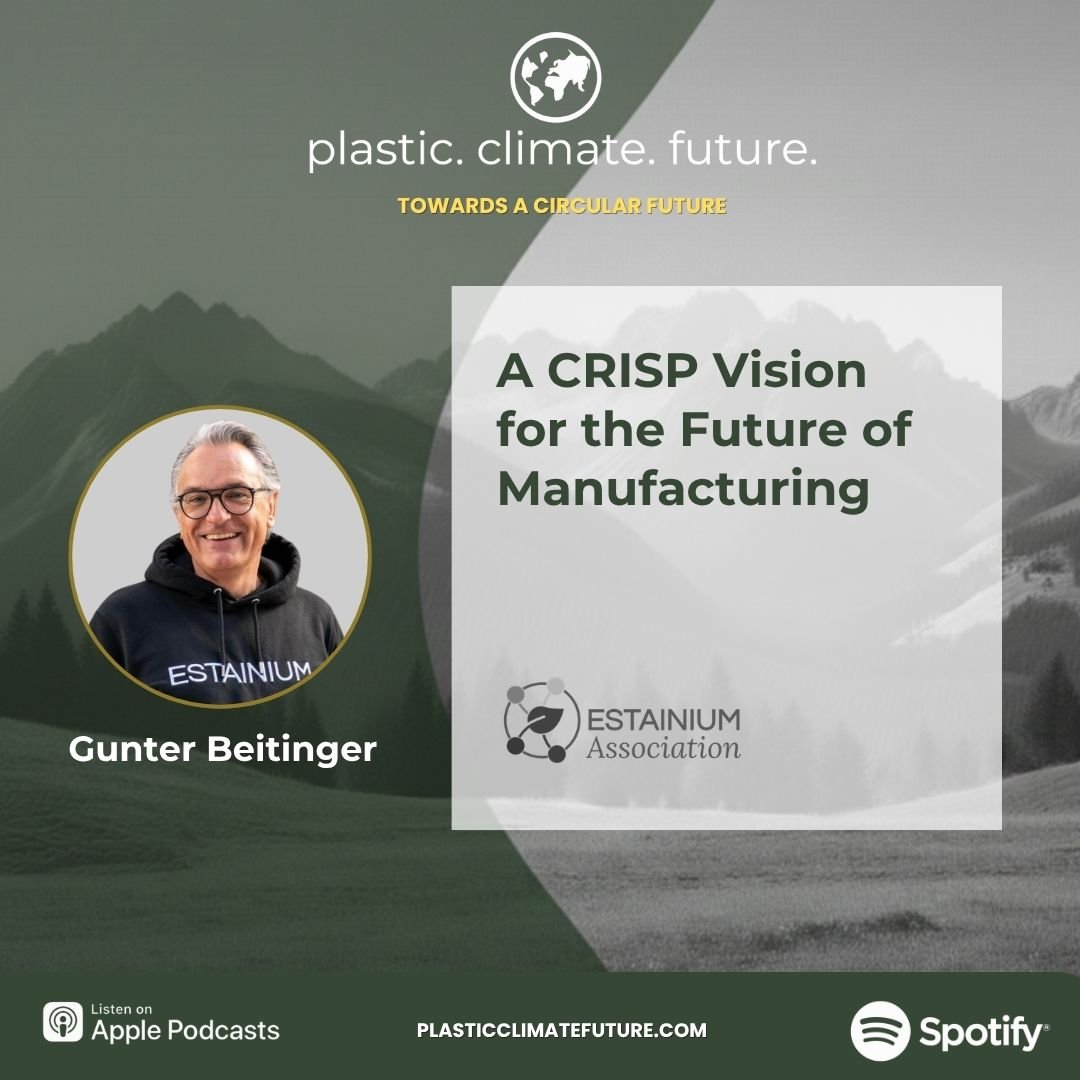
A CRISP Vision for the Future of Manufacturing

A CRISP Vision for the Future of Manufacturing

What does it take to make industry truly future-ready?

In this episode, we speak with Gunther Weidinger, founder and chairman of Estanium and former Siemens executive, about how manufacturing can become more connected, resilient, intelligent, sustainable and people-centric — or, in one word: CRISP.

Drawing on more than three decades of industrial experience, Gunther shares why the biggest challenges facing manufacturing cannot be tackled in isolation. Digitalization, resilience, sustainability, AI and people all need to become part of the same transformation.

We discuss:

  • What CRISP manufacturing means — and why factories need a more holistic approach to transformation

  • How trusted data sharing can create transparency across complex supply chains

  • Why circularity can strengthen both sustainability and industrial resilience

  • Why technology alone is not enough — and the role trust, collaboration and people play in making transformation work

And the conversation continues in Munich!

📅 On October 20, Gunter will moderate the Munich Climate Week event “Your Suppliers Own Your 2030 Emissions Target”, with Matt joining the panel alongside experts from procurement, supply chain and sustainability.

The discussion will explore one of the key themes from our conversation: how companies can turn supply-chain decarbonization ambitions into measurable action.

Register here: Your Suppliers Own Your 2030 Emissions Target — Munich Climate Week

The technologies are evolving quickly. But building the future of manufacturing is about more than adopting the latest tools. It is about connecting technology, sustainability, resilience and people into one coherent industrial system.

Or, as Gunter puts it: keeping it CRISP.

🎧 Listen now on Spotify and Apple Podcasts — and see you at Munich Climate Week!

Read More

When Recycling Starts with Design

When Recycling Starts with Design

Another episode of our series with Plastics Europe Deutschland is out! This time, we look at why successful recycling often starts long before a product reaches the end of its life — at the design stage.

We speak with Dr. Alexander Azzawi from Evonik about the technologies that can make plastics easier to separate, repair and recycle.

From inks that can be washed off packaging to adhesives designed to debond on demand, Alex shows how innovations at the design stage can enable higher-quality recycling and more circular material flows.

We discuss:

  • How de-inking technology can improve the quality of recycled plastics

  • How “debonding on demand” can make products easier to repair, disassemble and recycle

  • Why circular solutions require collaboration across the entire value chain

  • Why designing for recyclability is becoming increasingly important as circularity requirements reshape the market

Circularity doesn’t begin at the recycling plant. Increasingly, it begins with the choices we make when products and materials are designed.

Listen now on Spotify and Apple Podcasts!

Read More
Beyond Sustainability: The Strategic Value of Circularity

Beyond Sustainability: The Strategic Value of Circularity

In this episode, we speak with Dr. Jens Hamprecht,  VP Global Plastics Steering Committee & Sustainability at BASF, about the transformation of the plastics industry and why circularity is becoming increasingly important for Europe's industrial future.

From innovative recycling technologies to reducing dependence on imported resources, Jens shares his perspective on the opportunities and challenges of building a circular plastics industry.

We discuss:

  • How BASF is advancing circular plastics through innovative recycling technologies and industry collaborations

  • Why scaling circular solutions requires market demand, investment and collaboration across the value chain

  • How circularity can strengthen Europe's industrial resilience and resource independence
    Why clear and stable regulatory frameworks are essential to accelerate the transition

  • Circularity is no longer just an environmental ambition. It is becoming a strategic opportunity to strengthen Europe's industrial future.

Listen now on Spotify and Apple Podcasts!

Read More
Scaling What Matters: From Innovation to Industry

Scaling What Matters: From Innovation to Industry

Last week in Berlin, Germany’s innovation ambitions took center stage. Our series with Plastics Europe Deutschland continues with another example of the technologies and companies shaping its industrial future.

We speak with Melanie Hackler and Eva Kamp from matterr about what happens after you develop a promising recycling technology: how do you actually scale it into an industrial business?

matterr has developed a chemical recycling process that breaks polyester-rich waste back down into its original building blocks. Those recycled monomers can then be used again in existing polyester production — turning waste into a new raw material.

But technology alone doesn’t create a circular economy. Scaling requires reliable waste streams, sorting infrastructure, customers, investment and an ecosystem capable of bringing all of those pieces together.

We discuss:

  • How matterr’s technology tackles complex polyester waste that conventional recycling struggles with
    What it takes to move from a pilot plant to industrial scale

  • Why circular materials have to compete with linear production systems optimized over decades — and the role regulation and investment can play in enabling the transition

  • Why Germany’s infrastructure, expertise and industrial ecosystem can provide a strong foundation for scaling the next generation of circular technologies

The technology is there. The need is clear. The challenge is taking circular solutions from promising innovations to competitive industrial scale.

Because for circular technologies to matterr, they have to scale.

🎧 Listen now on Spotify and Apple Podcasts!

Read More
Turning Germany’s Industrial Strength into Action

Turning Germany’s Industrial Strength into Action

This week, Germany’s plastics industry takes its innovation story to Berlin — and our series with Plastics Europe Deutschland looks at what it will take to turn industrial strength into action.

Ahead of this week’s innovation press conference, we sit down with Christine Bunte from Plastics Europe Deutschland to discuss what Germany’s plastics industry can contribute to the country’s high-tech ambitions — and what needs to happen to turn that potential into action.

Germany has strong industrial capabilities, material expertise and an active innovation landscape. But having the right ingredients is not enough. The challenge now is to move faster and get into the “do stage.”

We discuss:

  • Why plastics and material competence are essential to Germany’s High-Tech Agenda — from e-mobility and renewable energy to electronics and robotics

  • What industry needs from policymakers — including competitive energy, infrastructure, less bureaucracy and stronger incentives for transformation

  • What progress could realistically look like three years from now — and why transforming industrial competitiveness will take time

This week, many of these ideas will take center stage at the innovation press conference in Berlin, bringing together voices from industry, startups and academia to discuss the future competitiveness of Germany’s plastics industry.

The capabilities are there. The innovation is there. Now the question is how to turn Germany’s industrial strength into action.

🎧 Listen now on Spotify and Apple Podcasts!

Read More
A Front-Row Perspective on the Plastics Industry

A Front-Row Perspective on the Plastics Industry

Our series with Plastics Europe Deutschland continues with a perspective from someone who has been observing the chemical and plastics industries from a front-row seat for more than three decades.

Michael Reubold is a polymer chemist by training — but instead of working directly in the plastics industry, he has spent more than 30 years observing, reporting on and engaging with it as Editor-in-Chief of CHEManager.

That gives him a unique perspective on how the industry has changed, the challenges it faces today, and where it could go next.

𝗪𝗲 𝗱𝗶𝘀𝗰𝘂𝘀𝘀:

  • How the plastics industry — and the way we talk about it — has changed over the past three decades

  • Why today’s combination of climate, waste, energy and competitiveness challenges makes this transformation different

  • How innovation ecosystems connecting startups, academia and established industry can help Germany and Europe reinvent the sector

  • Why circularity, material sovereignty and the right policy environment are becoming increasingly important for Europe’s industrial future

Despite the scale of the challenges, Michael remains optimistic. The knowledge, infrastructure and innovative capacity are there. The task now is to connect these strengths and create the conditions for the industry to reinvent itself.

🎧 Listen now on Spotify and Apple Podcasts!

Read More
The Invisible Chemistry Behind Safer Materials

The Invisible Chemistry Behind Safer Materials

Flame retardants rarely get much attention. Yet they play an important role in enabling the plastics used across electronics, electric vehicles, renewable energy technologies, buildings and many other high-tech applications.

In this episode, we sit down with Dr. Adrian Beard from Clariant to explore the science behind flame retardants and the challenge of combining fire safety, material performance and sustainability.

We discuss:

  • How flame retardants help make polymers suitable for demanding high-tech applications

  • Why electrification, batteries and renewable energy technologies are creating new material safety challenges

  • Why developing a new flame retardant can take five to ten years from the initial idea to commercial scale

  • How fire safety and circularity can be reconciled, and why durability and recyclability sometimes create difficult trade-offs

  • How sustainability and regulation are changing the way new chemistries are developed

  • Why even more sustainable solutions still need a viable business case and market acceptance

It’s a fascinating reminder that some of the technologies enabling innovation are almost invisible in the final product. We may never see the chemistry, but without it, many of the materials and technologies we rely on would not perform as safely as they do.

Listen now on Spotify and Apple Podcasts!

Read More
When Conventional Recycling Isn't Enough

When Conventional Recycling Isn't Enough

Our series with Plastics Europe Germany takes on another key question for the future of plastics: What happens when conventional recycling isn't enough?

In this episode, we sit down with Marcel Beermann, CEO of ARCUS Greencycling Technologies, to explore the role chemical recycling can play in tackling mixed and difficult-to-recycle plastic waste — and what it takes to turn these waste streams back into valuable resources.

We discuss:

  • Why mechanical and chemical recycling can complement each other, rather than compete

  • How mixed plastic waste can be converted into pyrolysis oil and used again as feedstock for new plastics

  • What it takes to scale chemical recycling from technology to industrial reality

  • Why regulation and market demand will be critical to creating a viable circular economy

  • How making better use of our own plastic waste can strengthen Europe’s resource resilience and industrial competitiveness

One thing becomes clear: Europe already has a significant resource in its plastic waste. The question is how we make better use of it.

Listen now on Spotify and Apple Podcasts!

Read More